You know that old Hofi Géza joke about “if you don’t have an aquarium…”? Well, I do have an aquarium. It has been fitted with 12 V LED lighting for quite some time. And there was a small problem with it.
When a DC Connector Starts Getting Warm
The lighting cable had a conventional round Ø5.5 × 2.5 mm DC connector pair in line, so I could disconnect the aquarium hood from the timer and power supply whenever necessary. There is no really consistent current rating for connectors of this type. Some manufacturers specify 3–4 A, while better-quality versions are sometimes advertised by sellers as being good for as much as 5 A — which may or may not be true. The nominal dimensions alone tell you very little. Contact design, spring pressure, materials and manufacturing tolerances matter just as much.
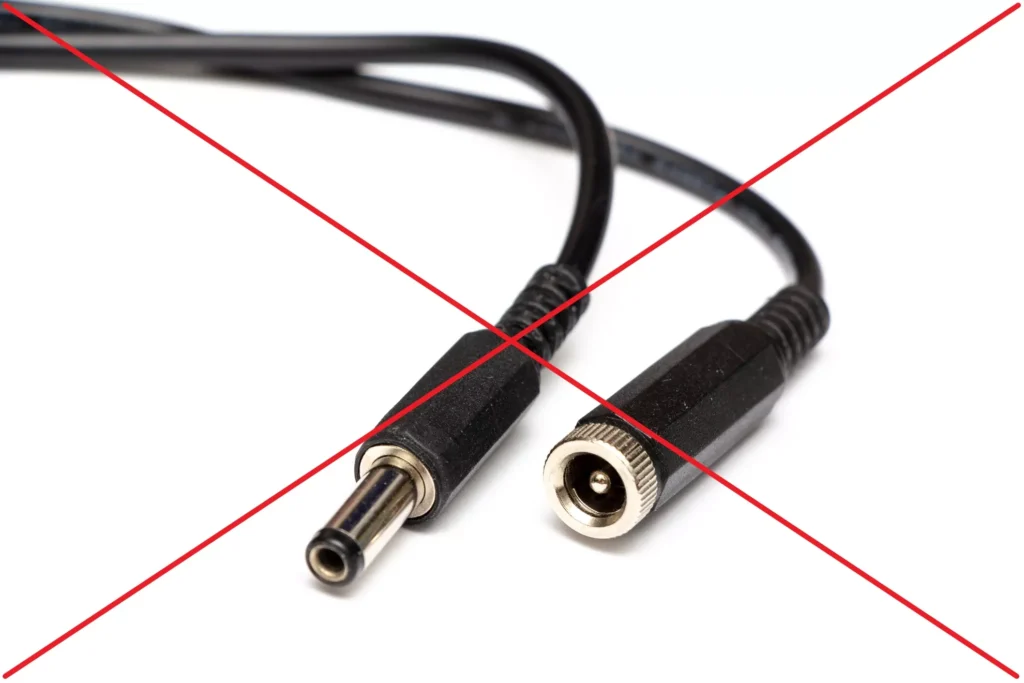
In practice, I noticed that the connector in my aquarium lighting cable was getting warm. A closer inspection showed that the male plug did not fit the female socket particularly well. It was not making firm contact with the two flat spring contacts inside the socket, and the centre pin connection did not seem reliable either, because the whole plug could move and wobble slightly. This sort of poor contact can get worse over time. As contact resistance increases, more heat is generated, and in an extreme case an overheating connector can even become a fire hazard. It is worth checking connections like these around the house from time to time.
Why I Chose the AMASS XT30
I decided that this was a job for a different connector. After some searching, I settled on the AMASS XT30. The XT30 family is widely used for batteries, RC equipment and other low-voltage applications carrying relatively high DC currents, so low contact resistance and a mechanically secure connection are important parts of its design. Its two gold-plated brass contacts slide firmly into one another under spring pressure, while the plastic body is polarised, so it cannot be connected the wrong way round. According to AMASS, the XT30U is rated for 15 A continuous current and 30 A peak current, with a contact resistance of 0.70 mΩ, and 18 AWG wire is recommended. For my 12 V LED lighting, which draws only a few amps, that leaves plenty of headroom. More importantly, once connected, the XT30 sits firmly in place with no wobble.
There is, however, one slightly odd thing about the XT30, at least if you want to use it as an ordinary inline cable connector rather than inside an RC model or battery pack: the basic version has no proper rear housing. The wires are soldered directly into the solder cups at the back of the connector, and the joints are normally insulated individually with heat-shrink tubing. That makes perfect sense in the world the XT30 comes from. In RC models, and especially in drones, size and weight matter, so there is little reason to add the sort of bulky outer shell normally found on general-purpose cable connectors.
AMASS also makes an XT30H version with a plastic rear cap. This covers and protects the solder joints, eliminates the need for separate heat-shrink over them and provides a certain amount of bend protection. What it does not provide is conventional strain relief: it does not clamp the cable’s outer jacket in the way, for example, a mains plug normally does.
Heat-shrink tubing provides perfectly adequate electrical insulation for the solder joints, but only limited mechanical protection. With a freely hanging cable, much of the pulling force and repeated bending can still be transmitted all the way to the solder joints. For a connector used around the home, I would much rather have a closed housing that I can actually grip than a couple of solder joints covered with heat-shrink. In other words, the XT30 was almost overqualified electrically for this job, but as an inline cable connector it was missing one small thing: a proper housing.
So I Designed My Own
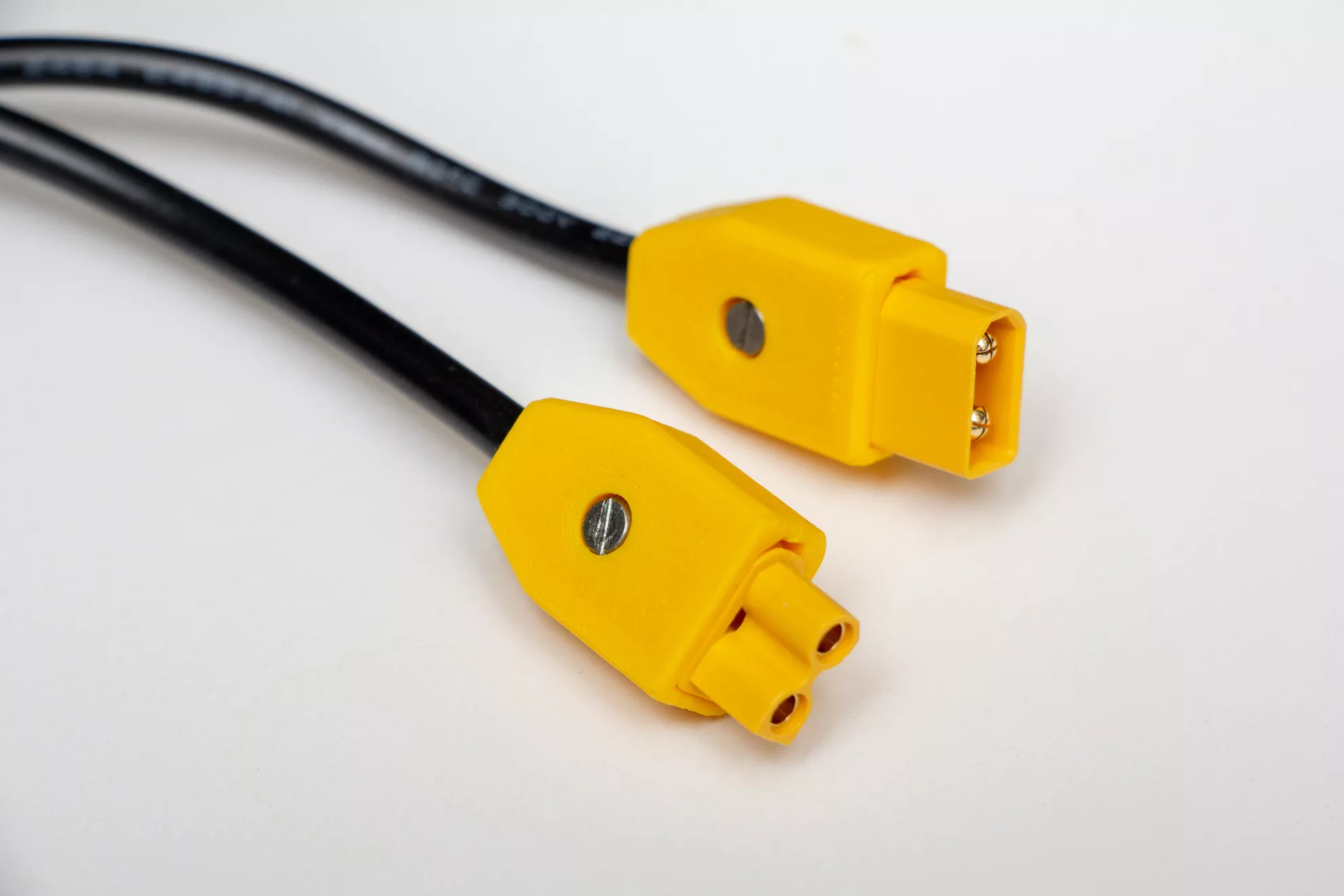
There are plenty of downloadable XT30 housings on 3D-printing sites, since the connector is popular in RC modelling. Many of them, however, are designed for two separate, relatively thick 14–16 AWG silicone wires, which are commonly used in higher-current RC and drone applications. My cable was quite different: a round cable only Ø3.4 mm in outside diameter, containing two conductors of roughly 20 AWG. I did not want any pulling force on that cable to be transferred directly to the solder joints.
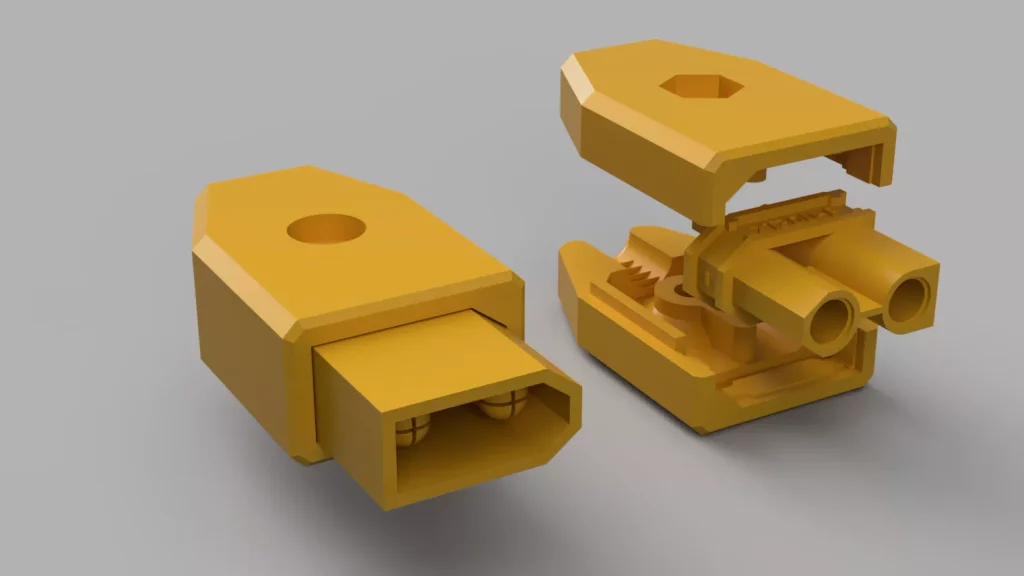
What I needed was a housing that would grip the cable jacket itself, much like the internal cable clamp in a 230 V mains plug, only on a much smaller scale. It also had to hold the XT30 body firmly enough that the connector could be unplugged by pulling on the housing rather than on the wires. Since I could not find anything designed specifically for a thin round cable like mine, I quickly designed one myself.
Printing the housing is straightforward. Both halves can be printed flat on the bed without supports. With a 0.4 mm nozzle, a 0.20 mm layer height works perfectly well; 0.15 mm is a good option if you want slightly finer detail. Since the part is small and has to withstand some mechanical stress, I recommend 100% infill, or at least four perimeters. Assembly requires just one M2 × 7 mm pan-head or round-head screw and one standard M2 nut; a button-head screw works as well. Since M2 × 8 mm is the more common standard length, that will probably be easier to find. If you use an M2 × 8 mm screw, simply file about 1 mm off the end.
Material choice depends on where the connector will be used. PETG, ABS or ASA are preferable if it will be installed inside an enclosed aquarium hood, near lighting that runs continuously, or close to a power supply where temperatures may rise. PLA is perfectly usable in cooler applications where there is no significant local heat buildup, but I would not choose it for a location that may regularly get warm.
The STL files are available on Printables: https://www.printables.com/model/1845142-amass-xt30-strain-relief-housing-slim-for-o34-mm-c