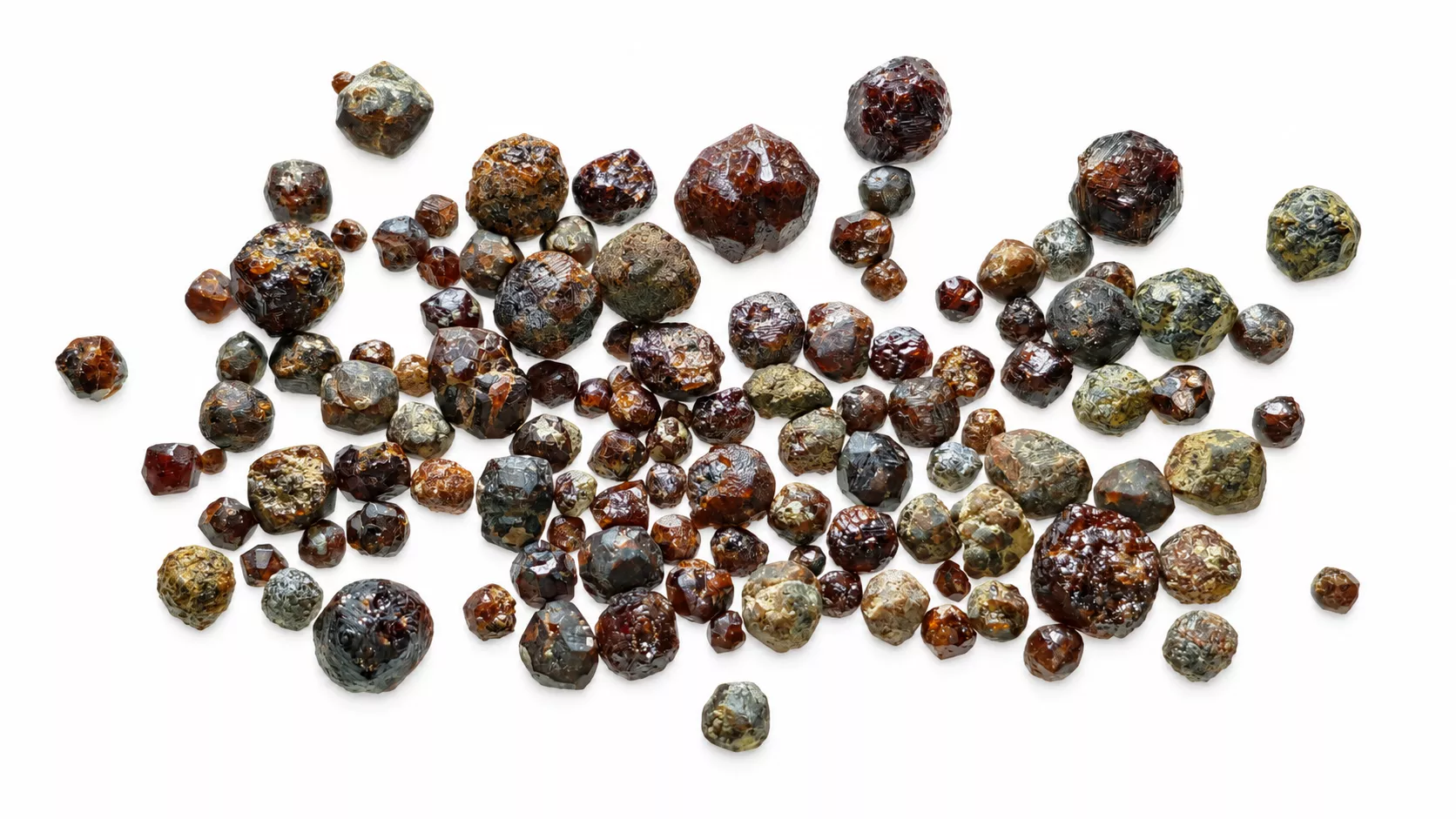
For most of us, the Börzsöny Mountains bring to mind andesite, old mines and volcanic landforms. Yet one of the range’s most distinctive minerals is a genuine gemstone: almandine, the iron-rich member of the garnet group. Most Börzsöny specimens would hardly belong in a jeweller’s window, but they are all the more interesting geologically. These tiny, usually dark reddish-brown crystals preserve evidence of processes deep beneath the volcanoes that were active here 16 million years ago.
What is almandine?
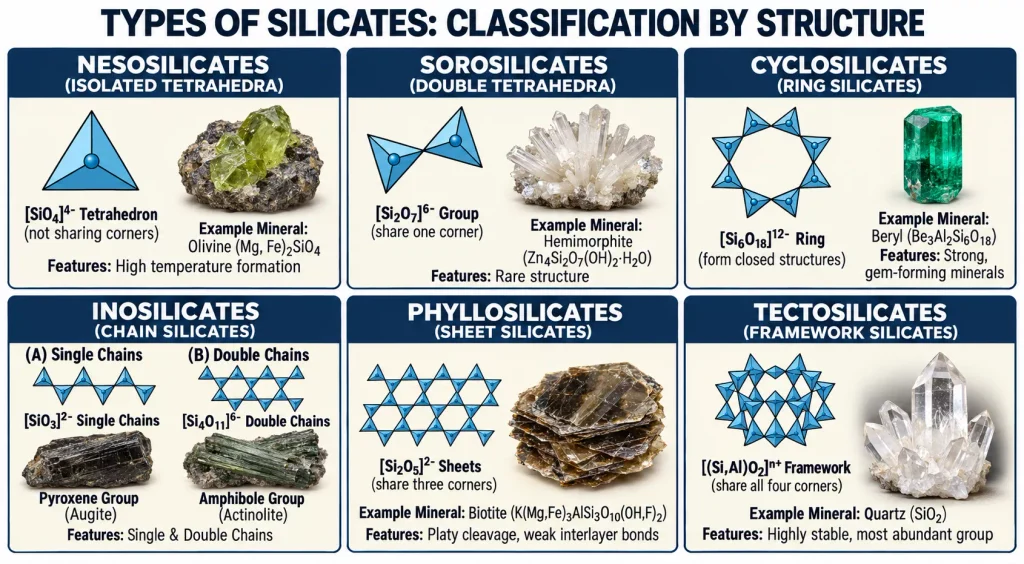
Garnet is actually a group of silicate minerals with the same crystal structure, rather than a single mineral. Silicates are the largest and most widespread class of minerals on Earth: estimates suggest that roughly one-third of all known minerals are silicates and that silicate minerals make up 90% of the Earth’s crust. Even so, scientists long found their structures difficult to understand, perhaps because silicates are so diverse and often so complex. They were once regarded as salts of hypothetical “silicic acids”. Then X-ray diffraction studies in the 1920s and 1930s revealed their actual crystal structures: the framework of silicates generally consists of [SiO₄]⁴⁻ (silicate) tetrahedra. Silicate minerals can be divided into five subclasses according to how these tetrahedra are linked:
- Nesosilicates, or island silicates: their structures contain isolated [SiO₄]⁴⁻ tetrahedra that are linked by metal cations rather than directly to one another;
- Sorosilicates, or group silicates: the [SiO₄]⁴⁻ tetrahedra join directly to form groups of two, three, four or six;
- Inosilicates, or chain silicates: the [SiO₄]⁴⁻ tetrahedra link together in chains;
- Phyllosilicates, or sheet silicates: the [SiO₄]⁴⁻ tetrahedra link in two dimensions to form sheets;
- Tectosilicates, or framework silicates: the [SiO₄]⁴⁻ tetrahedra link in all three dimensions to form extensive frameworks.
A note on classification: many sources place the ring-forming cyclosilicates in a separate subclass alongside the sorosilicates, as the illustration below does. Koch and Sztrókay’s Ásványtan, however, treats sorosilicates, with their paired tetrahedra, and ring-forming cyclosilicates as separate major groups within one subclass. That theoretical point of taxonomy need not detain us: our garnets belong to the first subclass, the largest of the five, and specifically to the garnet group.
The minerals of the garnet group are therefore nesosilicates: their [SiO₄]⁴⁻ tetrahedra are connected through metal cations, not directly to one another. Their general formula is R²⁺₃R³⁺₂(SiO₄)₃. The R²⁺ sites can contain calcium, magnesium, iron(II) or manganese ions; the R³⁺ sites can contain aluminium, iron(III), chromium or, in some cases, titanium. The garnet structure is the most complex of the nesosilicate structures. Its intricate symmetry arises because the metal ions and oxygen atoms form regular polyhedra between the silicate tetrahedra.
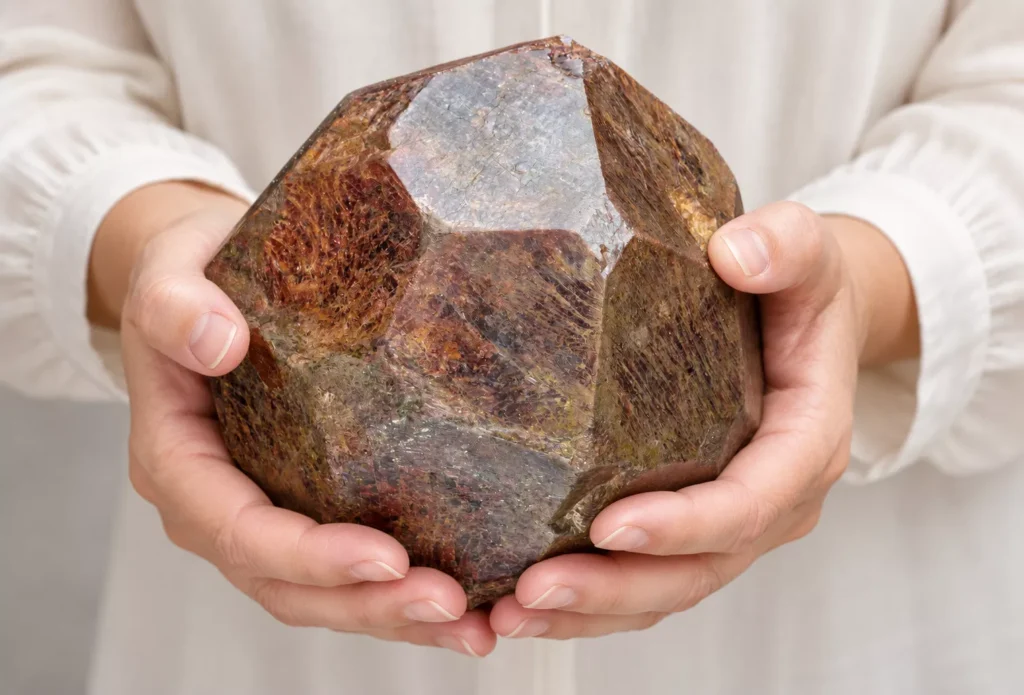
Almandine is the “iron garnet”. Its ideal chemical formula is Fe₃Al₂(SiO₄)₃: it is an iron–aluminium silicate. The picture is more complicated because manganese (Mn²⁺) can replace some of the iron, while Fe³⁺ can replace some of the aluminium. Despite this elaborate internal structure, almandine is the most common garnet. It can be brownish red, purplish red or sometimes almost blackish brown. Its red, burgundy and purplish hues are due primarily to Fe²⁺ ions in the crystal lattice. Mn²⁺ tends to modify the colour; by increasing absorption in the violet part of the spectrum, it can generally shift the colour towards red or orange. Almandine may be translucent or opaque. Its opacity can also be increased by iron, inclusions, fractures and iron-rich weathering products. It crystallises in the cubic system, commonly as rhombic dodecahedra or trapezohedra. Its hardness is about 7–7.5 on the ten-point Mohs scale: it scratches glass and cannot be scratched with a needle or steel knife, while a file will not bite into it. Its density is around 4 kg/dm³, making it a relatively dense, heavy mineral. Intact, unaltered almandine garnet has no cleavage, or only very poor cleavage (although parting along {110} may occur); its fracture is usually conchoidal or uneven. It occurs chiefly in crystalline schists (for example near Sopron) or gneiss, and also as an accessory mineral in andesitic rocks that intruded clay-rich rocks (for example at Csódi Hill near Dunabogdány, around Szokolya and at Karancs).
Well-known localities in the Börzsöny
Börzsöny almandine often looks like a simple black grain. Hold it up to a strong light, however, and its thinner parts may reveal a characteristic deep burgundy or red. Garnet’s hardness and relatively high density help crystals released from weathering volcanic rock resist destruction; they accumulate in streambeds and placer deposits. This dry autumn is an especially good time to look: the summer heat has gone, and dry streambeds let us search freely among the piles of sediment.
Three notable sites in the Börzsöny are worth visiting: Gránát Spring, Királyrét and Kóspallag. You cannot see all three on a single day hike, so it is best to choose one.
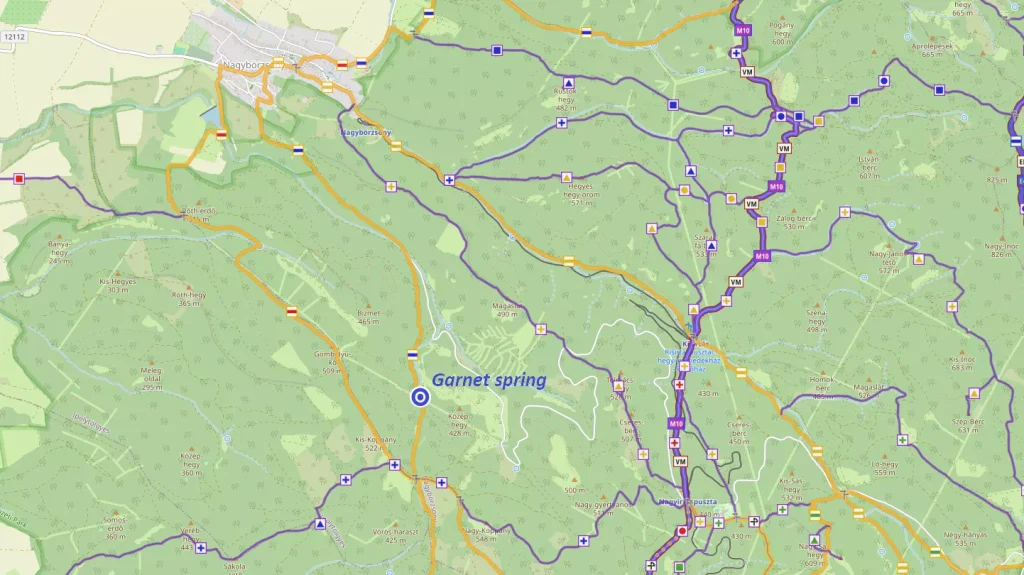
Gránát Spring near Nagybörzsöny
This is the locality with the most telling name. Written records of Börzsöny almandine date back to the mid-eighteenth century, and the name “Gránát-kút” (“Garnet Well”) has been known for a long time. Near the spring, look for almandine in the stream sediment. With a little luck, a trained eye may also find magnetite, corundum, spinel, augite and other accessory minerals. The valley floor and streambed are filled with fluvial sediment, derived largely from the tuff on either side of the valley (the Nagyvölgy Dacite Tuff Formation) and from the andesite higher up on the mountain tops (the Nagykoppány Andesite Member). Water releases hard garnet grains from weathering volcanic rock, carries them away, then deposits them again according to their density and grain size. In other words, look downstream in the stream, rather than in the spring itself. The best spots are where heavy minerals settle: in eddies behind large stones, in small hollows and wherever the current slows.
As late as the first half of the twentieth century, large numbers of pilgrims visited the famous Marian shrine at Márianosztra. One pilgrimage route passed close to Gránát-kút, and travellers always stopped to rest at the spring. They collected minerals they called “diamond stones” or “pearl stones” (especially the children and young people), tied them into the corners of their handkerchiefs and took them home as keepsakes. According to tradition, the Virgin Mary had washed here while passing through, and the “pearls” had fallen from her necklace into the spring.
The quickest way to reach the spring is from Nagybörzsöny, through Farkas Valley on the blue Börzsöny trail. It is 4 km from the bus turning area at Hunyadi Square (about an hour’s walk), with a manageable total ascent of roughly 180 m. You can also cycle down the paved road from Nagyirtáspuszta towards the Tolmács-hegy loading area, as far as the entrance to the Gránátos Stream valley. That route is 7.6 km and almost entirely downhill on the way out; the return is correspondingly almost all uphill, although the climb is only about 200 m.
My recommendation is to drive via Kóspallag to Nagyirtáspuszta, where you can also stop for a good lunch at the Szent Orbán restaurant. Parking in front of the restaurant is free. From there, follow the B✚ trail marking towards Mézesfa. At Mézesfa, leave the marked trail and take the unmarked forestry road towards Homoki-kút and Gránát Spring. The route is a little longer at 4.3 km, but mostly downhill, with only around 135 m of total ascent. The return is a little more strenuous, but the 200 m climb is still manageable. If you would rather not walk the same route twice, you can return along the paved road. Alternatively, on Saturdays and Sundays you can continue down to Nagybörzsöny and take the Nagybörzsöny Forest Railway back to Nagyirtáspuszta. You will need an early start to catch the last train (timetable here).
Királyrét and the Gránát-hegy area
Alongside Királyrét, the name Gránát-hegy (now Vár-hegy) appears repeatedly in old geographical and mineralogical literature. Garnets from the Börzsöny—near Szokolya, Diósjenő, Verőce, Nagybörzsöny and Nagyoroszi, for example—have been recorded since the 1750s. We know about their use by local people in the eighteenth century from a Latin work by László Turóczi. Citing Turóczi in his description of Nógrád County, Antal Mocsáry wrote that “garnet stones are so plentiful in the Jenő hills that peasant hunters load them into their guns instead of bullets; garnets the size of hazelnuts have also been found. I too had a garnet brought from there, large, clear and roundish.”
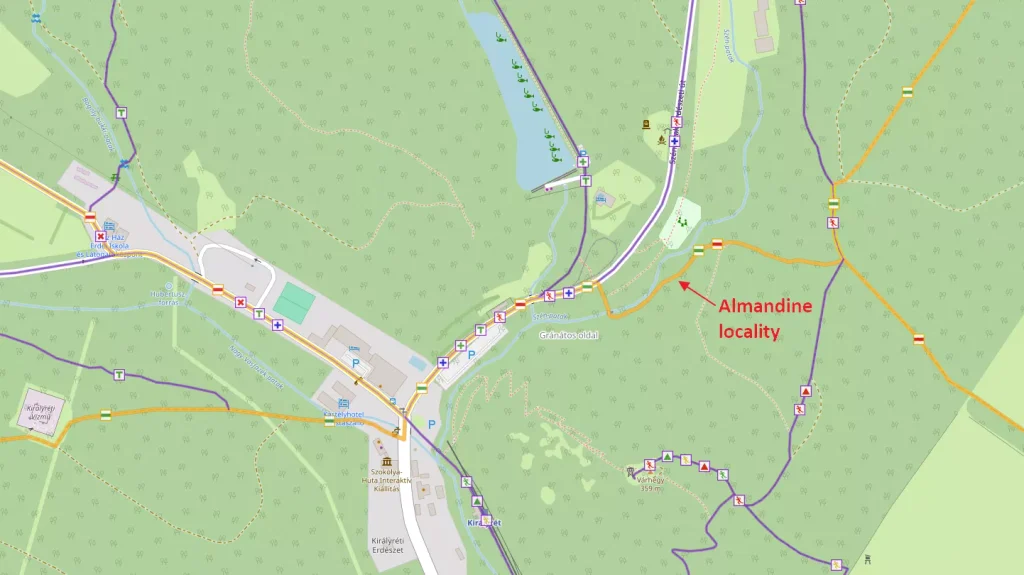
Gránátos-oldal at Királyrét is the easiest locality to reach: you can drive almost all the way there. Go through Szokolya to Királyrét; the site is about 300 m from the central car park. Be aware that parking fees apply at Királyrét on weekends. The train is another option. MÁV’s G70 and Z70 services run hourly to Kismaros station. From Kismaros, you can take the Királyrét Forest Railway or buses 351 and 352 to Királyrét.
From the car park, set out along the R▬ / G▬ marked trail on the Szén-patak forestry road, then turn right after about 100 m. Cross the bridge over Szén Stream and you will see three adits from the former iron mine ahead of you. Királyrét, formerly called Szokolya-huta, was part of the Esterházy estate in the seventeenth century, when iron-ore mining began here. The ore was processed locally in iron furnaces and in water-powered hammer mills driven by the Morgó Stream. Production ended by 1793 because water power was insufficient, the estate was reorganised, and tariff policy was unfavourable. The former hammer mill was then used only for sawing timber. The most important adits were around Vasbánya-hegy and at the foot of Öl-hegy, where the Jakóby adit was still worked in the first half of the twentieth century. The three adits visible here on the flank of Vár-hegy were smaller workings dug for exploration only, each just a few tens of metres long. They expose a dacite outcrop (Nógrád Dacite Member). The rock is relatively stable, but you must not enter the adits because of the risk of collapse—and there is nothing to see inside anyway. The adits are winter roosts for strictly protected bats. Disturbing bats during hibernation can easily kill them, another reason to stay out.
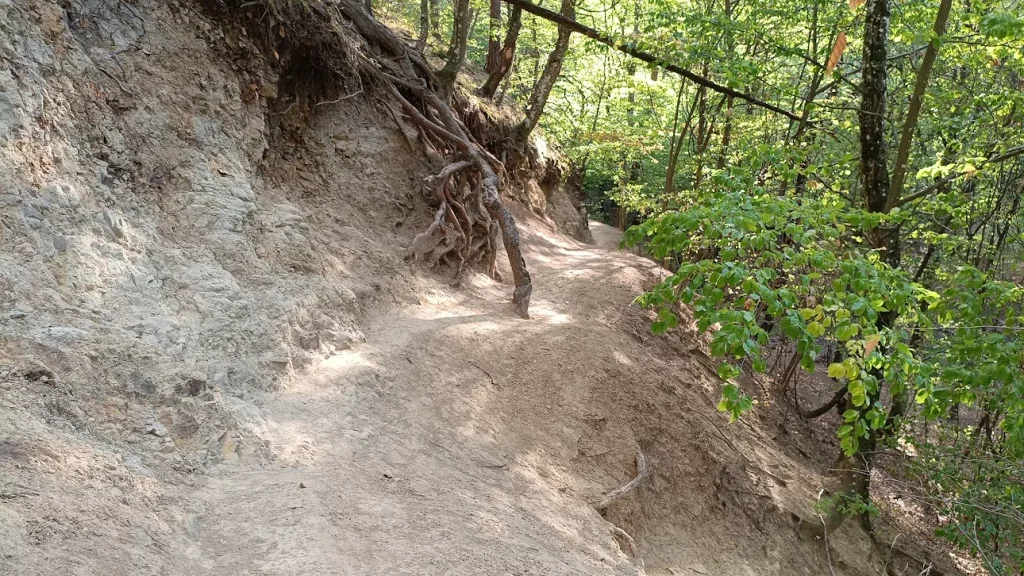
Continue uphill on the hiking path for another 100 m to reach the locality. Take care: the slope is continually collapsing. On one occasion a large block of rock fell onto the path. The trail markings were recently repainted, but no warning was posted about the danger. The path is narrow in places, and its loose, crumbly ground makes it easy to slip; in some spots you could slide down a steep drop. Wear sturdy hiking boots, and do not bring small children to this locality. Avoid the area during a thaw after freezing weather because of the danger of falling rock.
Unfortunately, the place where garnets can be found is precisely the hazardous section, where they weather out of crumbling dacite tuff. A keen observer may spot grains of various sizes in the tuffaceous slope. It is also worth looking through the weathered material at the foot of the rock face and on the path.
This is a particularly good place to explain the journey of a garnet crystal. It first forms in a deep magmatic system. A volcanic eruption then carries it towards the surface, enclosed in dacite or andesite. Over millions of years the rock breaks down and weathers, but the almandine is harder and more resistant than its surroundings, so it eventually falls free. The stream performs the final step: it transports the crystals and concentrates them in places.
It is also worth mentioning that weathered-out silicate minerals and attractive pieces of opalised wood can be found in the sediment of streams around Királyrét—especially Szén Stream—in the area between Ajta-berek and Szalatnya, and at the foot of surface rock outcrops. Collecting placer minerals has its own tricks, which I will not go into here.
When you have had enough of searching, follow the R▬ trail uphill to the lookout, 60 m higher up. It gives a fine westward view over the High Börzsöny: Darabos-hegy, Nagy-Inóc, Magas-Tax, Nagy-Hideghegy and Égés-tető frame the panorama. Farther north come Csóványos, Három-Hárs, Saj-kút-bérc, Bárány-bérc and Borsos-hegy. To the south, Tar Péter-hegy and Pap-hegy block the view, but a gap reveals the Pilis: Nagy-Morgó, Urak asztala and Kis-Bükk-tető. Close ahead, Szőlő-hegy hides Szokolya, with the dark bulk of Naszály rising in the background. To the east you can then see Nagy-Kő-hegy and the already mentioned Öl-hegy and Vasbánya-hegy. In clear weather, Karancs is visible far to the northeast, as is Király-hegy (Kráľova hoľa), the easternmost peak of the Low Tatras, at 1,946 m.
Do not return from the lookout to the car park by the dangerous path. The shortest comfortable route follows the G lookout trail; another option, with a short detour towards Széles-mező, is the Y lookout trail. Both descend towards the rail-bike track. The R lookout trail is a longer way round via the Fatornyos inn. On that route you will also pass another, largely filled-in mine known as Hevér-lyuk. The path follows Szén Stream back to the car park. With a little luck, you can find more almandine in the stream beside the playground; sapphire has even been found there.
Kóspallag and the Korompa and Kis-Hanta streams
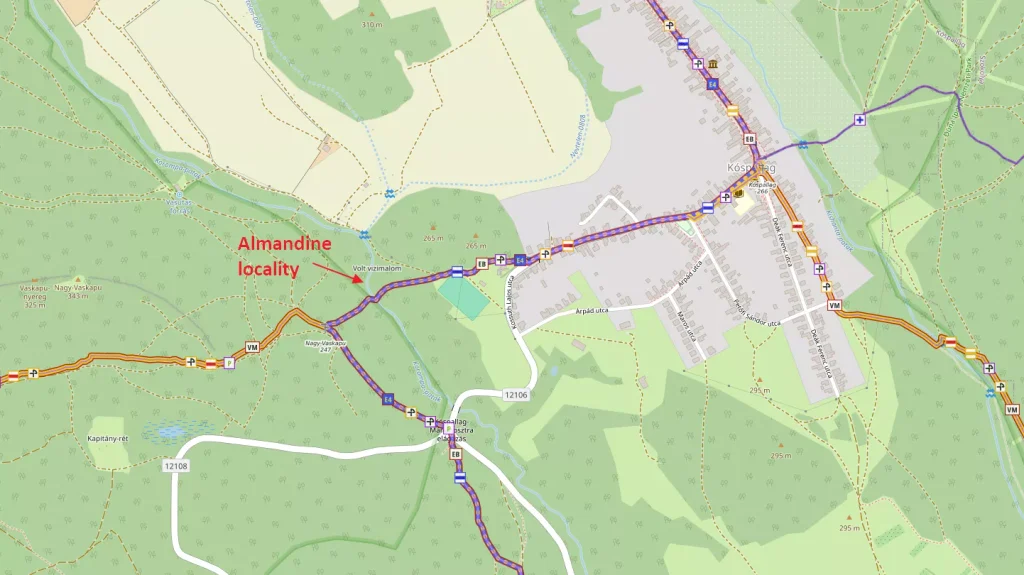
At Kóspallag, the search is another textbook example of alluvial geology. Most of the water in the Kóspallag basin drains into the Korompa and Kis-Hanta streams. The stretch of Korompa Stream behind the football pitch is a well-known almandine locality. Here you can see how water carries away lighter quartz, feldspar and rock fragments while denser garnet, magnetite and other heavy minerals become concentrated in particular spots.
From Kóspallag, follow the R▬ / B▬ trail west past the football pitch. After about 200 m downhill into the valley, you reach the stream. A watermill once stood here; traces are still visible, although the mill itself disappeared long ago. This is where you can search.
What should you bring?
Apart from ordinary hiking gear, you need virtually none of the usual mineral-collecting equipment. A 10× hand lens and a pair of tweezers are more than enough for a close look at grains in the stream sediment. Leave the geological hammer and chisel at home: you will not need them on this trip, and you must not break into exposures, rock faces or streambanks.
How big can a Börzsöny garnet be?
According to the standard Hungarian mineralogical reference A magyarországi ásványfajok by Sándor Szakáll, István Gatter and Géza Szendrei, almandine crystals in the andesites and dacites of the Visegrád Mountains, Börzsöny, Cserhát and Karancs can reach 0.5–2 cm. In an 1826 account, Antal Mocsáry reported garnets the size of “magyaró”—hazelnuts—from the area. Pieces that large are rare today, however: most finds are only 1–2 mm across.
One of New York’s geological celebrities is the Subway Garnet, an almandine crystal found beneath Manhattan’s 35th Street in 1885, actually during sewer construction. It weighs about nine pounds, or a little over 4 kg, and is nearly 15 cm in diameter. Today it is an iconic specimen in the collection of the American Museum of Natural History. How big can the largest get? The world’s largest known mass of garnet has been reported from Norway: it is about 2.3 m across and weighs 37.5 tonnes. It is, of course, not gem quality. The largest garnets in our wider region occur in Austria’s Habachtal valleys, at elevations around 3,000 m. Specimens 5–10 cm across can be found in the mica schist there. The almandines of Tyrol’s Zillertal are especially famous. Garnet was mined there from the mid-eighteenth to the early twentieth century. Crystals sufficiently clear and free of fractures were used as gemstones, and substantial quantities were sent to garnet-cutting workshops in Bohemia.
Why was there no garnet mine in the Börzsöny?
Garnet has economic value. Fine red almandine has been a popular gemstone since antiquity, often cut as a smooth, domed cabochon or faceted. Some people believe it has healing powers (it is widely claimed to restore energy and promote recovery), but that is nonsense. Almandine that is not gem quality is a valuable industrial abrasive because of its hardness. Yet it was never mined in the Börzsöny, for two reasons. First, mining here focused on more valuable materials: gold, silver, non-ferrous metal ores and iron ore. Second, Börzsöny garnet is generally of poor quality.
A jeweller wants crystals that are large enough, intact, relatively free of fractures and, above all, transparent or at least highly translucent. Attractive almandine is red, burgundy or crimson; a stone with too much iron, however, can look almost black. Medium-sized cut stones often look best. Large stones are frequently too dark, so they are often cut fairly thin. Clarity and freedom from fractures are essential. Classic sources of gem-quality almandine include India, Sri Lanka, Madagascar and the United States. Sri Lankan alluvial deposits, for example, have long yielded fine gem-quality almandine, while material from Idaho can display a star effect, or asterism.
Most Börzsöny specimens are just a few millimetres across, often brownish to dark red and insufficiently clear. Their chief defect is that they are usually fractured, owing to effects during the magma’s ascent and to weathering at the surface.
How does garnet get into a volcano?
That is the really interesting question. Almandine is best known from metamorphic rocks such as mica schists and gneisses. In the Börzsöny (and the Visegrád Mountains), however, it occurs in andesite and dacite—and in relatively large quantities. This is quite rare worldwide. The phenomenon is so unusual that Zoltán Balla and Erika Csillagné Teplánszky devoted a paper to it as early as 1979, titled A börzsönyi gránát eredete és petrogenetikai jelentősége (“The origin and petrogenetic significance of Börzsöny garnet”).
Almandine crystallises in the lower crust (at depths of about 20–45 km) under high pressure (7–12 kbar) and temperature (800–940 °C). At shallower depths, almandine in a magma melt becomes unstable and changes into other minerals. The magma from which it crystallises must also be rich in aluminium and water.
More recent geochemical studies suggest there is no single origin story. Three types of garnet have been distinguished in the almandine-bearing andesites and dacites of the northern Pannonian Basin:
- Primary garnets, which crystallised directly from magmas derived from the mantle.
- Secondary garnets, in which a new layer of garnet grew from the magma around a garnet core of foreign origin (a xenocryst).
- Garnets from the metamorphic lower crust, torn loose by the moving magma.
As the Pannonian Basin extended, faults and fractures formed that allowed magma from depth to rise rapidly. The almandines formed at high pressure thus had no time to dissolve completely back into the magma. This is why we can now find crystals formed deep underground in volcanic rock that solidified at the surface.
The fractures in Börzsöny almandines are probably the result of several overlapping processes, many directly associated with volcanism. As magma rises, three things happen at once: pressure falls, temperature changes and the chemical equilibrium of the melt surrounding the garnet shifts. A garnet stable at depth may no longer be stable at lower pressure. It may partly dissolve back into the melt or undergo chemical reactions; mechanical stresses can also develop and cause cracks. Stresses also arise outside the crystal: garnet and the surrounding feldspar, pyroxene and amphibole expand and contract at different rates. Microfractures can therefore form both at the boundary with the host rock and inside the crystal. Existing inclusions or growth zoning can create further points where stress is concentrated. A third factor, though not the strongest, is the eruption and rapid cooling of lava or pyroclastic material.
There is one more factor: Börzsöny rocks have been weathering for some 15–16 million years. Garnet is hard and relatively resistant, but water can enter existing cracks, freezing and thawing can occur, and the surrounding rock disintegrates. Once a crystal falls out of the tuff or andesite and is transported in a stream, it may suffer further mechanical damage. Irregular, often branching cracks running through the crystal are probably older and may even have formed deep underground. Discolouration or infilling by another mineral along a crack may indicate that the crack existed long ago and was later penetrated by fluids. Fresh, sharp chips and broken surfaces are more likely to result from later weathering or impacts during stream transport.
How should we clean our finds?
Börzsöny almandine is quite hard and chemically resistant, so the safest way to remove weathered tuff stuck to it is generally to soak it in water and clean it mechanically.
- Start by soaking it in lukewarm water for one or two days. A little washing-up liquid is fine. This often loosens porous tuff that has weathered to clay considerably.
- After soaking, remove adhering material with a fairly stiff toothbrush under running water.
- Material left in hollows can be teased out with a wooden toothpick, a bamboo stick, or a needle or tweezers. Be careful with a steel needle: although almandine itself is hard, the crystal can split along existing cracks.
An ultrasonic cleaner may also work, but only for sound, intact grains. Börzsöny garnets are often fractured, and ultrasound can open existing cracks further.
Do not use aggressive chemicals such as hydrochloric acid, nitric acid or sodium hydroxide (drain cleaner). Almandine itself can withstand a great deal, but its surface, any minerals within its cracks and any coatings may react. If the coating is especially clay-rich, a soak in sodium hexametaphosphate may be worth trying. It disperses clay minerals, making dried-on fine tuff much easier to remove. Rinse very thoroughly afterwards.
There is an important limit: if the garnet is firmly embedded in andesitic or dacitic rock or tuff, removing all the host material may not leave a good-looking specimen. It is better to retain some matrix than to keep scraping until the edges of the crystal chip.
Final thoughts
The pleasure of hunting for Börzsöny garnets lies in this: a tiny burgundy grain glinting in stream sand is a messenger from the volcanism that built these mountains 16 million years ago. It is also a mineral whose crystallisation may have begun tens of kilometres beneath our feet before magma brought it to the surface. It may never become a gemstone; it may be a little small and a little brown—but it is ours!
An important rule: The Börzsöny localities described here lie within the Danube–Ipoly National Park, an area protected under national law. Although many online hiking guides encourage collecting, Section 38(1)(a) of Act LIII of 1996 on Nature Conservation requires a permit from the nature conservation authority (in this case the Pest County Government Office) to collect in a protected natural area. The administrative service fee for the permit procedure is currently HUF 10,000, and the decision period is 90 days. An application must specify exactly where, when and how the proposed collecting will take place, its purpose and its anticipated extent. It is also advisable to consult the Danube–Ipoly National Park Directorate before applying. You must not take minerals home without a permit: even removing a garnet grain lying on the surface or in stream sediment may count as collecting. Without a permit, observe and photograph any finds, then leave them where they are. Unauthorised collecting may result in a nature conservation fine; its amount depends on the circumstances and any damage to nature (up to HUF 500,000 under Government Decree 33/1997). No mineral is worth that risk. If you’d like some Börzsöny garnets of your own, you can find specimens for next to nothing at mineral shows—presumably collected years ago or with a permit. Breaking into or digging in exposures, streambanks and streambeds, or disturbing them with tools, is especially to be avoided. Even with a permit, you may collect only in the manner and quantity it specifies.